Parts of the sentece

Parts of the sentece

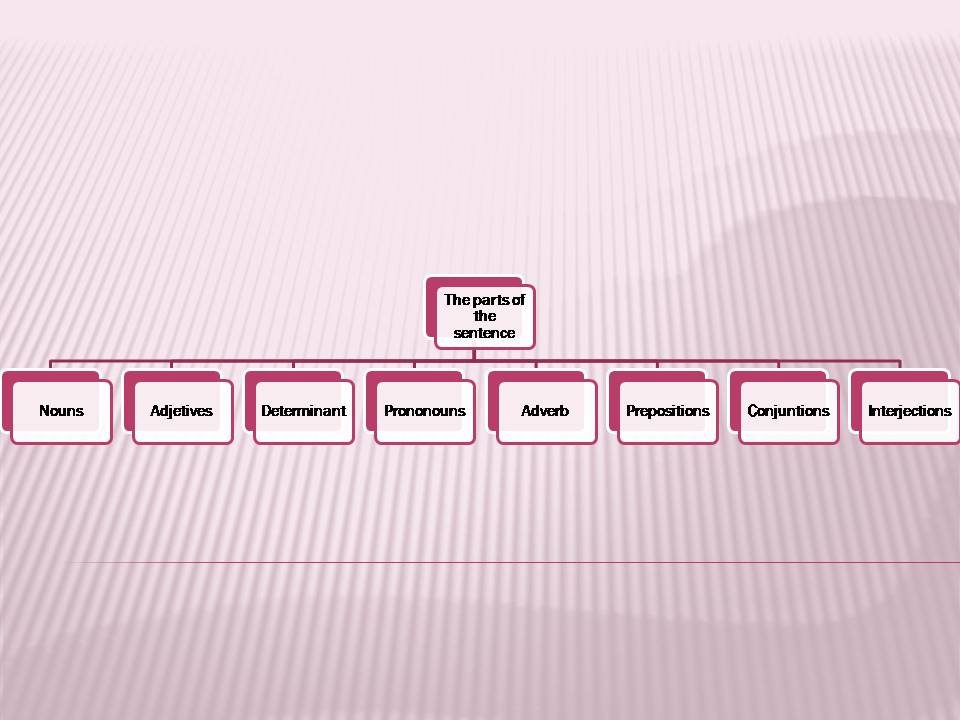
The parts of the sentence are different kinds of words and among them we have: nouns, adjectives, determinants, pronouns, verbs, adverbs, prepositions, conjunctions and interjections. In this post we are going to talk about what are these kinds of words and what are the types or the classification that exists within them. I know it sound a little complicated.

Let’s start with the Nouns:

The nouns are those that refer to the beings, objects or ideas that we have in the sentence; between the different types of nouns we have: the common, the own, the concrete, the abstract, the individual, collective, countable and uncountable. Nouns must have gender and number; and the adjective and the determinants must coincide with the gender and the noun number. The gender can be feminine or masculine depending on the termination of the word and the number can be plural or singular depending on whether it refers to a single unit or several units.

For example: La casa es grande

Now Adjectives

Adjectives describe the noun or a pronoun basically adjectives are capable of modifying the noun or pronoun. These adjectives can be positive, comparative, comparative equality, superlative, possessive and demonstrative. Adjectives generally go after the noun although there are some exceptions where the adjective can precede the noun.

For example: La chica es inteligente

 Now let’s talk about the Determinants

Basically the determinants accompany the noun and generally must coincide in gender and number with the noun. Among them we have articles that can be defined or undefined: those defined are generally those that are used for something known and those that are undefined for the unknown.

For example: La oficina está lejos

The Pronouns

The pronouns replace the noun. We will have different types of pronouns. We can have personal pronouns that will be represented by the grammatical person, possessive: things or ideas possessed, objectives that replace the direct complement, interrogation: beings or things whose identity is unknown, relative: substantive expressed in the omitted sentence that has already been mentioned before, demonstratives that replace the noun and denote distance with respect to who speaks, undefined: beings things or ideas whose identity or quantity is imprecise, and the reflexive that verbal action goes towards the subject.

For example: Ella es mi mama

Then we have the Adverbs

Adverbs complement the verb, the adjective or another adverb. Can be: place, time, quantity, manner, affirmation, negation, and doubt; usually they are located before the adjective that they modify but after the verb. Many are created by adding the word “-mente” to the singular feminine form of an adjective, but not all of them exist that are exceptions to this.

For example: Ella hizo exactamente lo que le pedí

When we talk about Prepositions

We must understand that these are words that link words. Many verbs require a preposition after the verb.

For example: Yo voy en camino a mi casa

Conjunctions 

They are words that link words phrases sentences, that is; With these conjunctions we can create a complete paragraph by joining words with words and sentences with sentences.

For example. Te voy a acompañar, pero saldré tarde del trabajo

Finally we have the Interjections

Although they are rarely used in the written word they are widely used when we are talking, these interjections represent a more or less sudden emotion such as Bravo!

For example. Ay, este examen esta dificil. 

The parts of the sentence are very important in fact we cannot have a complete knowledge of a sentence if we do not understand and identify each of its parts, its uses. your exceptions and what are the basic rules for using them in our daily or written conversations.

I hope this post has been very helpful and you can use it to understand the parts of the word and you can deepen it much more in the following publications. If you have any questions or comments, do not hesitate to write to me.
Verb tenses (Simple present)

Simple present

Use:

→Actual state.

→Real facts.

→Usual actions.

→Future schedules.

 Present
 Yo aprendo
 I learn
 add to the infinitive:
 arerir
Yoooo
aseses
Él, ella, ustedaees
Nosotros (as)amosemosimos
Vosotros (as)áiséisís
Ellos (as)anenen

For example

 CaminarBeberPermitir
YoCaminoBeboPermito
CaminasBebesPermites
Él, ella, ustedCaminaBebePermite
Nosotros (as)CaminamosBebemosPermitimos
Vosotros (as)CamináisBebéisPermitís
Ellos (as)CaminanBebenPermiten

Yo camino todos los días a las 6:00 a.m.

Ellas beben leche todos los días antes de dormir

Nosotros permitimos el paso de los vehículos

Interjections

Interjections

They are used to express more or less sudden emotions. They do not change shape and we write them with exclamation marks, at the beginning and at the end of the word.

proper interjection is one that has a simple phonetic body and does not fulfill any other grammatical role. For example “¡Bah!” (“No tengo ganas limpiar. ¡Bah! en realidad estoy muy cansada”), “¡Eh!” (“Eh! Ten cuidado al cruzar la calle ”),“ ¡Zas! ”(“ Estaba caminando y de repente ¡Zas! se me cayó el teléfono en la alcantarilla”).

An improper interjection, on the other hand, develops on the basis of adverbial, verbal, adjective or nominal forms: “¡Dios mio!” (“¡Dios mio!! ¿Por qué hizo eso?”), “¡Bravo!” (“Eres el primero de tu clase. ¡Bravo! ”),“¡Ojo! ”(“ Él no es un hombre de confiar: ¡Ojo! Ten mucho cuidado ”).

Interjections can also be divided into expressive or appellate. Expressive interjections, also called symptomatic, are oriented to the speaker himself (“¡Ay!”). Appellative interjections or directive interjections, on the other hand, are oriented towards the listener (“¡Hola!”).

The most common are:

¡Ah!

¡Bah!

¡shh!

¡Eh!

¡Ea!

¡Guau!

¡Oh!

¡Ey!

¡Puaf!

¡Zas!

¡Uy!

¡Uff!

¡Ay!

¡Bravo!

¡Caramba!

¡Dios mio!

¡Ojo!

¡Hola!

Conjunctions

Conjunctions

 They are an invariable part of the sentence, they usually do not have an accent and are defined as words or a set of words that are used to link words, phrases or sentences.

They may be:

Coordinates when they have the same syntactic category

Subordinates when elements of different categories are presented, so that one is subordinate to the other.

Among the most common conjunctions we have:

Y

 e

 ni

 pero

  sino

 Aunque

 sin embargo

 no obstante

 porque

 además

 Asimismo

 aparte de ello

 incluso

 más aún

 también

 en cambio

 al contrario

 antes

 primero

 después

 luego

  más adelante

 posteriormente

 a continuación

 así como

 incluso

 por eso

 desde – hasta

Preposition

Preposition

Many Spanish verbs necessarily need to be complemented by a preposition, such as: “Advertir de”, “Carecer de”, among others.

Prepositions are usually found at the beginning of the syntactic constituent to which they modify. By linking words, prepositions function as invariable parts of the sentences that are responsible for denoting the link of the terms to each other.

It is important to keep in mind that the different prepositions can come to indicate a great variety of elements. Thus, for example, they can be used to indicate a place, an origin, a motive, a means or even a destination, among many other things.

To understand this, just use the preposition “a“. Thus, when used in the phrase “Voy a la biblioteca”, it comes to indicate an address, while if it is used in sentences such as “Estamos a 5 de mayo de 2019” it makes clear one day.

The preposition are 23: 

 a

 ante

 bajo

 cabe

 con

 contra

 de

 desde

 en

 entre

 Asia

 hasta

 para

 por

 según

 sin

 sobre

 tras

 durante

 mediante

 versus

 día

Adverbs

Adverbs

Unchanging part of the sentence that can modify the meaning of the verb, an adjective or another adverb or a whole sentence

Semantically expresses circumstances of place, time, mode, quantity, order, doubt, among others, and its main function in the sentence context is that of circumstantial complement, for that reason it can answer questions such as where?, how? when? and how often?

It is located before the adjective that they modify but usually after the verb. Many are created by adding the ending -mente to the singular feminine form of an adjective. Note that many adjectives have the same form in feminine

For example: 

Exacto – exacta (fem) = exactamente

Feliz – feliz (fem) = felizmente

Dulce – dulce (fem) = dulcemente

Común – Común (fem) = comúnmente 

There are many who do not form with the termination – mente. For example: ahí, ahora, allí, aquí, ayer, bastante, demasiado, despacio, mal, mañana, mucho, muy, nunca, poco, siempre, tan, ya.

 Among the adverbs that answers how? they are: Fácilmente, felizmente, rápidamente, lentamente, silenciosamente, elocuentemente, tristemente

For example: “Fui a trabajar rápidamente

 Among the adverbs that answers where? they are: lejos, en todas partes, aquí, adentro, cerca, afuera, ahí

For example: “Yo vivo cerca del parque”

Among the adverbs answers me when? they are: después, antes, temprano, ahora, desde, pronto, hoy, ayer, ya.

For example: “Hoy me levante temprano

Among the adverbs that answers how often? they are: Siempre, todos los días, frecuentemente, nunca, seguido, una vez, rara vez, algunas veces, dos veces.  

For example: “ Voy a trabajar siempre en la mañana”

Pronouns

Pronouns

They are words that are used to refer to people, animals or things without naming them, being in this way possible;  to replace the noun, define or vary the number, gender and even person in a sentence.

Among the different types of personal pronouns there are: 

 Personal pronouns refer to the grammatical person. They are: Yo, tú, usted, él, ella, Nosotros, ustedes, ellos

For example: “Diana está feliz” = “Ella está feliz” 

 Possessive pronouns that refer to beings, things or ideas possessed by someone. They are: mío, tuyo, suyo, nuestro.

For example: “La casa es de Juan” = “La casa es suya

 Objective pronouns are those that replace the direct and indirect complement. They are: directos me, te, lo, la, nos, los, las. indirectos  me, te,  le, les, nos

For example: “Luis le compró un regalo a Maria” = “Luis se lo compró”

 Interrogative pronouns refer to beings or things whose identity is unknown. They are: ¿Qué? ¿cuándo? ¿Cómo? ¿dónde? ¿por qué? ¿Cuál? ¿de quién? ¿quién? ¿cuánto?

For example: ¿Cuál es tu casa?

Relative pronouns refer to the nouns expressed in the sentence or omitted, already mentioned before. They are: que  el que, la que, el cual, la cual, quien, cuyo, cuya, donde, cuando

For example: “Esta es la casa que yo visité el año pasado”

 Demonstrative pronouns are those that replace the noun and denote distance with respect to who speaks. They are: este, esta, estos, estas;  ese, esa, esos, esas; aquel, aquella, aquellos, aquellas

For example: “Esta es mi casa”

 Indefinite pronouns are those that refer to things or ideas whose identity or quantity is inaccurate. They are: algo, nada, alguien, nadie, ninguno, cualquiera,

For example: “Alguien está tocando la puerta”

 Reflective pronouns are those in which verbal action goes to the subject. Between them we have: me, te, se, nosFor example “Me baño todos los días”

Articles

Articles

They accompany the noun and its function is to limit the extension of the noun.

For this we have two types of articles that can be definite or indefinite and must agree in gender and number with the nouns that they modify

Defined 

 They indicate a specific person, thing or place. The articles defined in Spanish are: el, la, los, y las. Which are translated into English (The) and are used with:

  • Infinitives used as nouns especially at the beginning of the sentence. For example: “El estudiar es bueno”
  • Nouns in a series. For example “Yo puse el libro, el lápiz, el cuaderno en la mesa”.
  • Certain nouns such as “la escuela, la cárcel”; where the article is usually omitted in English
  • Abstract concepts such as la bondad, la libertad
  • Nouns of weights and measures such as “ Las peras cuestan 1$ la libra”
  • Titles when used with a name. For example  “La Dra. García llamó”
  • Days of the week to indicate when something happens. For example when in English you use “on” in Spanish you use: “Voy al cine el sábado”
  • With body parts or articles of clothing; especially with reflective verbs for example: “Me pongo el abrigo” “Me tomó de la mano”
  • With the name of certain cities such as El Ecuador, La América del Sur, La Florida
  • Proper names modified by an adjective such as “El pequeño José”
  • When we are saying the time. For example “Es la una” “Son las dos”

Indefinite 

  • Indicate a non-specific place or thing the indefinite articles in Spanish are: un, una, unos, unas
  • They are used in the same way they are used in English and usually come before the noun
  • They are not used in certain situations such as after the verb to be when the noun followed by the verb to be unmodified For example I am a teacher Now we do use a modified noun we can say I am a good teacher

Neutral 

Also, do not forget that in Spanish we also use the neutral article “lo” to accompany adjectives, adverbs or participles.

The article never accompanies nouns.

Contraction 

a + el = al

de + el = del

For example: “Voy al cine” “Estas rueda es del carro”

Adjectives

Adjectives

They complement, specify, describe or modify characteristics to nouns, which they accompany adjacently in a sentence.

So, what they do is attribute to the nouns a certain quality that is concrete, tangible and perceptible through the senses.

Adjectives can be before or after nouns. It generally follows the noun it modifies. If, however, the adjective does not add any distinctive feature or emphasis, but rather readily associates with the noun they may precede the noun for example “La blanca nieve”. Also, demonstratives and possessives precede the noun. Some of the adjectives that go before the singular and masculine noun lose the last -o

For example:

After the noun: La mujer alta

Before the noun: La blanca leche

Adjectives depend on an adjacent noun to define its form: there are adjectives with a termination that do not vary according to the gender of the substantive word they accompany. And others that do vary their termination, such as terminations: bueno / buena, malo / mala, etc. Adjectives must coincide in gender and number with nouns.

Most male adjectives end in -o and most female adjectives end in -a, adjectives that don’t end in -o or -a use this form for both female and male. Adjectives can generally transform from male to female simply by adding an -a at the end of the word.

Adjectives can be classified into:

Descriptive: simply indicates certain qualities

For example: bella, amable, inteligente

Comparatives: indicate a quality in relation to two terms that have it in different intensity.

For example: Ella es mas hermosa que Luisa. Ella es menos hermosa que Luisa.

Comparatives of equality: which indicates a quality with the same intensity

For example: Ella esta tan hermosa como su hermana. Yo tengo tanto dinero como tú

Superlative adjectives: which indicate a quality at its highest degree of intensity

For example: Ella es la mas hermosa. ella es la menos hermosa

Possessive: indicate possession or membership

For example: Tu hermana es hermosa. Mi casa es grande

Demonstrative: indicating proximity or distance in relation to the person speaking

For example: Esta silla es grande. Aquella casa es de mi hermana

Nouns

Nouns

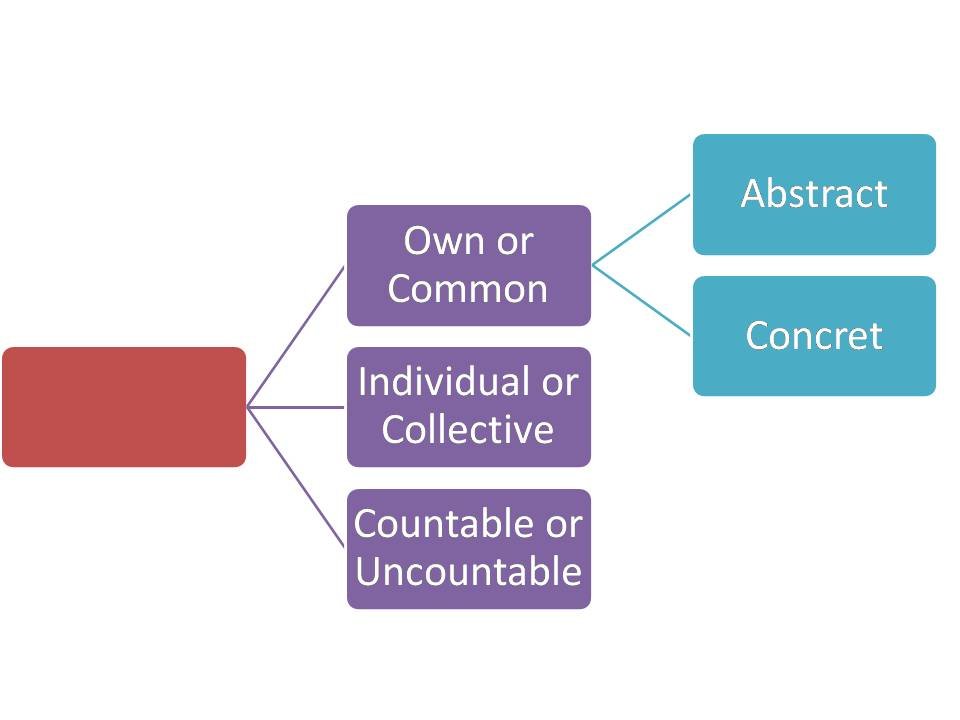
Classification of nouns

The noun is the core of the noun phrase, mainly of the subject of the sentence (the most important part of a sentence or speech). It is a word that identifies a person, animal, place, thing or idea.

It can be classified according to the things it names. First, the nouns are divided into:

Own or Common

  1. Own noun: which are those that name a being in a concrete way, whether an object or a subject, in a particular way. Own nouns are always capitalized and can be, for example, names of people or places (Juan, María, Uruguay).
  2. Common noun: which are those that designate a person, animal and object in a general way, such as casa, mesa, gato, profesor, selva, libertad, and so on. Common nouns are further divided between concrete and abstract.
  • Abstract nouns: which designate ideas and feelings that cannot be perceived by the senses, such as amor, tristeza, piedad, dolor, etc.
  • Concrete nouns: when they name things that can be perceived by the senses.

Individual or Collective

  1. Individual nouns: They name a particular being. for example: abeja, lobo.
  2. Collective nouns: They name beings globally or in a group. For example, “oveja” is individual and “rebaño” is collective.

Countable or Uncountable

  1. Countable noun: (for example “pera”, “silla”, “padre”)
  2. Non-countable noun: (“nieve”, “leche”, for example, we cannot say “dos leches” but “un litro de leche”).