How to Have a Basic Conversation in Spanish Without Feeling Overwhelmed

How to Have a Basic Conversation in Spanish Without Feeling Overwhelmed

Are you here because you want to navigate a conversation in Spanish without feeling like you’re drowning? Whether you’re fresh to the language or just looking for some simple phrases to get by, you’re in the right place. In this guide, I’ll equip you with the essentials to survive a basic conversation in Spanish without breaking a sweat.

Tips for Survival

Learning a new language can be daunting, but with the right approach, it becomes manageable. Here are some tips to help you navigate your way through a basic conversation:

Be Prepared

Before diving into a conversation, familiarize yourself with the basics of the language. Practice speaking beforehand, and get comfortable with the sounds and rhythms of Spanish.

Speak Slowly and Clearly

Spanish can be challenging to understand, so take your time when speaking. Clear pronunciation and slower speech will enhance your chances of being understood.

Listen More Than You Talk

Actively listening is key to learning any language. Pay attention to what others are saying, rather than focusing solely on your responses.

Don’t Hesitate to Ask Questions

If something is unclear, don’t be afraid to ask for clarification. Asking questions is an essential part of the learning process.

Learning Resources

Fortunately, numerous resources are available to aid your language learning journey. From books and apps to online courses, you have plenty of options to choose from. Additionally, immersing yourself in a Spanish-speaking environment can accelerate your learning.

Essential Phrases

To kickstart your conversational skills, it’s essential to learn some basic phrases. Here’s a list of must-know expressions:

  • Introductions
  • Greetings
  • Basic expressions
  • Common questions
  • Positive and negative responses

Start with mastering introductions, greetings, and basic expressions before progressing to questions and responses. Focus on simplicity and clarity to keep the conversation flowing smoothly.

Simplify and Practice

When learning a new language, simplicity is key. Don’t overwhelm yourself with complex grammar structures or extensive vocabulary. Instead, focus on mastering the present tense and gradually expand your knowledge over time.

Remember, speaking in short, concise sentences doesn’t diminish your language skills. In fact, it can make you sound more like a native speaker. Embrace simplicity and let your confidence grow with each conversation.

BONUS

As an added bonus, I’m excited to announce that I’m giving away a comprehensive conversation guide tailored specifically for small talk in Spanish. This guide is packed with essential phrases, useful expressions, and practical tips to help you navigate everyday conversations with confidence. Whether you’re chatting with locals during your travels or practicing with friends, this guide will be your go-to resource for mastering basic Spanish small talk. Don’t miss out on this valuable resource – grab your free copy today and take your conversational skills to the next level!

The ultimate guide for conversation practice, it contains the basic phrases and words to make easy sentences for the first time, it is confortable to carry and everything is on one page.

Learn More

Clic here to get it

Conclusion

Learning Spanish doesn’t have to be intimidating. By following these tips and dedicating yourself to practice, you can navigate basic conversations with ease. Remember to be patient with yourself and celebrate your progress along the way.

If you found this guide helpful, be sure to check out my website for a downloadable list of essential Spanish phrases. Don’t forget to subscribe to my channel for more language learning tips and resources. ¡Hasta luego! (See you later!)

What Type of Spanish should I start learning?

It is possible that you are confused with so many types of Spanish speakers and do not know what type of Spanish you should start learning. From Spain or from Latin America?

It is a common doubt among students of a new language, and a language like Spanish that has many nationalities with different slangs, is no different.

The answer will depend on your needs. If you want to travel to a particular country, live there or work there; If you want to be able to talk to your partner and she is from a particular country, it would be advisable to learn Spanish from that particular place or your partner’s nationality.

BUT .. something very important to understand is that each country has its own slang and words of the culture, but if someone who speaks Spanish travels to another country where they also speak Spanish: They will be able to understand most of the conversation but they will always a have some doubts. But they will be able to understand a lot, because much of her language is neutral.

Now if your goal is to travel to many Spanish-speaking countries, get to know many cultures, open your field of work. Then you must learn neutral Spanish.

Neutral Spanish is easier to learn, it is common in most countries and everyone will understand what you mean. Whether they are from Spain or any country in Latin America.

The best thing is that after you master this type of neutral Spanish, you can begin to learn the slang of each culture in particular

Did you know? Every time a native Spanish speaker travels to a country other than his own, he must learn the slang of that country. Because he will be a bit confused when he hear the different uses of his same words in other countries.

So my recommendation is that you learn neutral Spanish like the natives and then start to travel and get to know all those cultures and learn the different uses of the words that you already know

Was this advice helpful? Please leave a comment if you like it. If you have any more questions let me know.

What type of vocabulary should I start learning?

If you are reviewing this post it is because you don’t know where or how to start learning Spanish. The first thing you should know is that if you start learning random words, you are not going to use these words. You forget words that you don’t use, because we learn by repetition. If you want to learn effectively, start learning basic words from a regular conversation. Those words that you use regularly.

For example

𝐒𝐞𝐥𝐟 𝐢𝐧𝐭𝐫𝐨𝐝𝐮𝐜𝐭𝐢𝐨𝐧

When meeting a person, the first thing you should do is to introduce yourself and say some basic phrases about yourself.

Although it seems simple, introducing yourself can be a bit difficult, because they are structured sentences and sometimes they are translated differently into Spanish than they are in English. Also, it is better to memorize them than to translate them, to memorize all the common phrases so you don’t have to think a lot when introducing yourself. If you do not know which are the most common phrases to introduce yourself, check my post on 10 common questions and answers when you meet someone

𝐆𝐫𝐞𝐞𝐭𝐢𝐧𝐠𝐬

These are very necessary, every time you see someone you will greet them, so this is something that you will use many times and you will be able to learn very quickly. It is also something that you will learn by repetition. You should know that there are many different forms of greetings, and in fact each country has its own way of saying hello or goodbye. Some are common among the different Spanish-speaking countries and some you can only know if you go to that particular country. It is important that you learn them by memorization because the translation is never exact. If you do not know any of this check out my post on 10 common questions and answers to know how are you

𝐐𝐮𝐞𝐬𝐭𝐢𝐨𝐧𝐬

With the right inflection, a questioning word can say a lot on its own.

You can ask with just one word, which is very useful when you don’t remember a lot of vocabulary initially. You just have to give it the correct intonation and know what are the interrogative pronouns that you can use. The rest will be a bit easy once you have them memorized. If you do not know the interrogative pronouns, check my post about pronouns.

𝐍𝐞𝐠𝐚𝐭𝐢𝐯𝐞 𝐚𝐧𝐝 𝐩𝐨𝐬𝐢𝐭𝐢𝐯𝐞 𝐫𝐞𝐬𝐩𝐨𝐧𝐬𝐞𝐬

There are many negative or positive words that can give the right answer just by knowing one word o phrase. These are basically words that tell you negatively or positively phrases you use when someone asks or offers you something. You just have to think about what are those things that people around you always ask or ask you and make a small list that you can memorize. The most commons are:

No séI don´t know
No quieroI don´t want to
Quiero másI want more
Necesito tu ayudaI need your help

3 Reasons to learn Spanish

People always ask me: Why is learning Spanish important? Although it seems like just one more language, Spanish is one of the most important languages to learn. Although it is a difficult one to learn and you would have to put a lot of effort on your part, believe me when I tell you that it is worth it. In this post I am going to show you three super important reasons why learning Spanish can help you more than you think.

 Second most spoken language in the world

It is estimated that Spanish is the native language of more than 400 million people worldwide, which is equivalent to approximately six percent of the world’s population.  For this reason, if we are based on the number of native speakers, Spanish is officially the second most widely spoken language, ranking ahead of English.

So, if you want to talk to many people, or speak a common language: Spanish is the one. Also, if you speak Spanish and English, you can communicate with 80% of the world’s population. This means, speaking these two languages can give you advantages in many areas, especially work. DO NOT miss the opportunity to learn this language because the job of your dreams or the love of your life may be a language away.

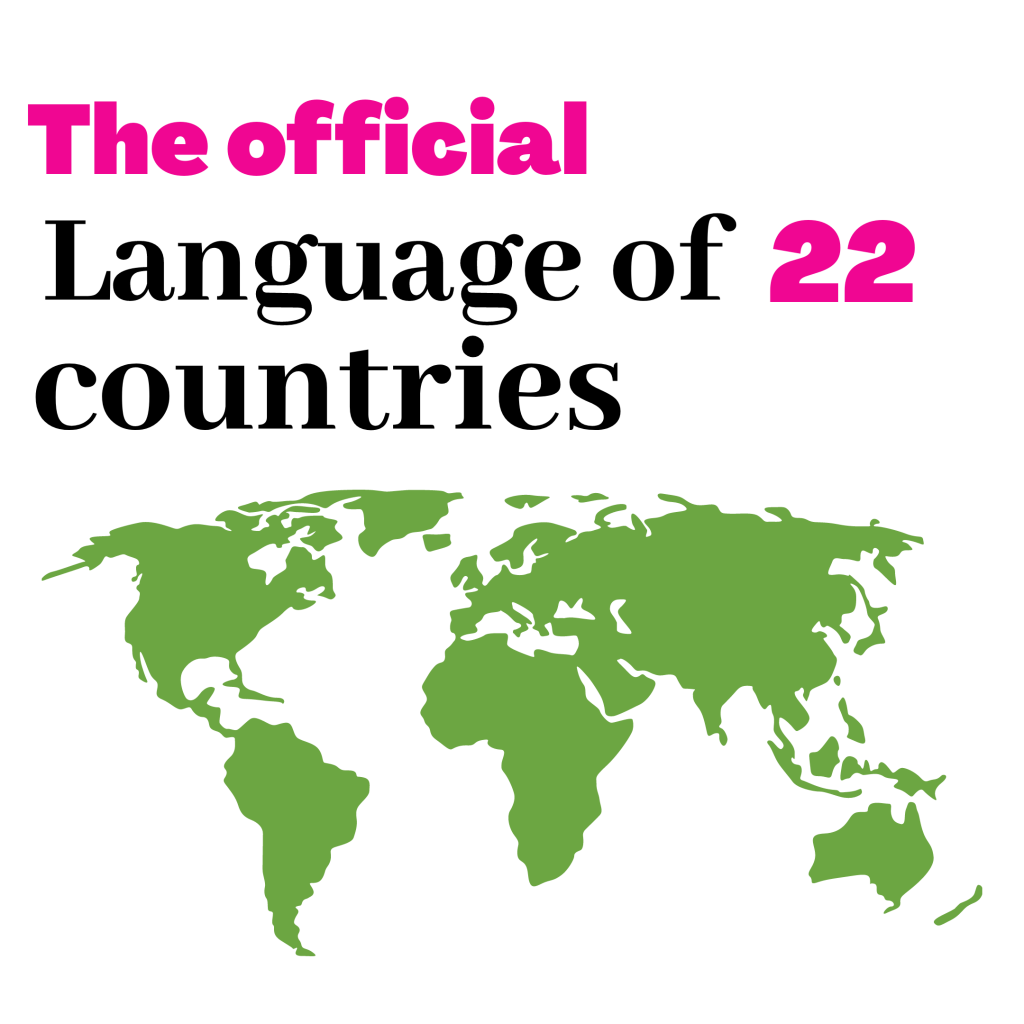
 The official language of 22 countries and more than 30 in which Spanish is spoken, although it is not considered the official language

Think how many countries you can visit if you speak Spanish.  The experience is not the same with a translated trip.  Speaking the language of the country you are traveling to will open many doors for you.  You don’t just limit yourself to visiting tourist areas.  The possibilities are endless.

Imagine visiting this country and knowing it as a native does, laughing at the jokes of the culture as only a native can. Language is the road map of a culture, it tells you where you come from and where you are going. This can make you see their culture from a totally different perspective. Also, if you speak to a person in a language they understand, the words will go to their head; but if you speak to him in his own language, they will go to his heart

• Increasing popularity

According to the Instituto Cervantes, which is the institution specialized in teaching Spanish in the world, 21.8 million people are Spanish learners in 107 countries

That’s right, because you’re not the only one who woke up one morning and decided that he wants to learn a new language, and that “the language” is Spanish. There are millions of people right now motivated to learn this beautiful language. And if you ask me, it feels like a movement, because more and more people are passionate about learning this language and as the years go by, it could be the most widely spoken language in the world. Just wait and see.

9 tips to improve your pronunciation

Are you a native English native, do you speak Spanish but your pronunciation is not as desired? Well, I’m going to give you nine tips here that will help you improve that pronunciation. But you must remember something important, to have a good pronunciation we must sharpen our auditory sense. First we listen well, and then we will be able to repeat correctly

1.- Learn to listen

This is not something simple, but quite necessary to do. The reality is that you must learn to listen, to separate words and distinguish similar words from each other in order to understand how to pronounce them.

2.- Listen passively

This is one of the best methods and is the one I recommend the most. I consider that it is the one that gives better results. Listening passively is something you can achieve by watching TV shows, listening to the radio, podcast, audiobooks, or also watching subtitled movies that are interesting to you. Although it seems that you are not learning. You will be learning, and little by little you will recognize the sounds better and it will be easier for you to pronounce them.

3.- Listen to songs and sing

 One of the most effective and fun ways to learn to pronounce Spanish better: is to listen to music and sing it. Believe me, you will have a lot of fun. you just have to find your style and start enjoying singing in Spanish

4.- Listen to original voices:

If the audios, songs and television you listen to, are voiced by people who are not native, you will not learn the correct pronunciation of the words. Always try to locate native audios in Spanish. Of course, if you speak directly with natives, it will be much better. You should always go to the source of information.

5.- Speak without shame

 Now you only have to talk after having used all these previous tips in which you basically must first listen well, then the next step is to talk. That’s right, talk without shame. Do not worry about mistakes since you can learn from them.

6.- Break down the sounds:

basically you are going to separate the words into syllables, so that it becomes a little easier for you to understand how the pronunciation of each syllable is. Take it easy, slowly use syllable by syllable and then move on. Little by little you get far. Then you will be able to start talking with the words much faster

7.- Pay attention to the movement of the lips:

The movement of your lips and your mouth is very important. Enough gestures. Remember that the Spanish language is spoken by moving your mouth a lot. At first you will feel a little strange but over time you will get used to it.

8.- Accentuate the sounds:

Do not forget to accentuate the sounds. Remember the words in Spanish have accents and you must be aware of them. Because each word changes with the accent. Although they are written the same, the accent gives them a different sound, which makes their meaning different.

9.- Record yourself

And finally do not forget to record yourself. Yes, record yourself. It is something very interesting that you can do to see how you speak and what are the things that you are failing and that you can improve.

Pronunciation Tips

I will start by giving you some small tips on how to pronounce some letters that may be preventing you from having a good pronunciation for example:

A

 Of course, the pronunciation of this letter is a bit different from the pronunciation in English. There are some common mistakes that tend to be made as native English speakers. The first is very closed mouth. In Spanish it is necessary to pronounce the letter “A” open the mouth sufficiently. Basically gesturing enough

H

It is a very simple letter to use in Spanish since it is always silent, that is, it has no sound; that is, when you see it, you just have to skip it.

Ll – Y

Something very important to note is the similarity between the sounds of the letter “Ll” and the letter “Y”. and it is that these two letters sound exactly the same, it is very easy to confuse them in Spanish because when we pronounce them they sound exactly the same. The sound of the letter “Y” is equal to the sound made when the letter “J” is pronounced in English

J

In Spanish you pronounce the “J” the way you pronounce the letter “H” in English. It’s a bit confusing, right? But we will achieve this with a lot of practice. Remember that to achieve a good pronunciation we must practice a lot

Z

 The letter “Z” and is a little simpler, since in Spanish it is pronounced as the letter “S”

B -V

It is a bit difficult because the “B” is pronounced by joining the lips and the “V” is pronounced by biting the lower lip. But their sounds are so similar that even the natives tend to confuse them sometimes

Activate your memorization

Activate your memorization

One of the most difficult things when learning a language is to memorize vocabulary. Many times we trust our memory to remember all these millions of new words in another language, that we want to be able to control. But although we can rely on our memory we should not let our memory be the only tool used to memorize. So, we can find so many ways to help our memory. For example:

Focus on useful words: if these words you are studying or memorizing are not words that you are going to use constantly, they are rare words or words little used in your day to day routine; then you will tend to forget these words and as they are not important to you, you will not repeat them very often, so you will not be able to memorize them.

Put the words in context: you can learn a lot of vocabulary. It is normal that in your learning process you find yourself with a lot, a lot of vocabulary, but remember that these words have to make sense to you. So give them a context for you, so you can remember them more easily. 

Find good sources of vocabulary: movies that are interesting for you, programs, series, podcasts, books, etc., all these are great source of interesting vocabulary. As long as these vocabulary sources are interesting for you, because if they are interesting to you, you can believe me that every word you read or hear you will never forget.

Create a map in your mind: where you can match the words that are related. If you match some words you have learned with other words you are still learning; These words that already have a strong connection in your memory will allow these new words to adhere to your memory much more quickly.

Create stories: when you find words that are very difficult to remember, try to use them in a story. Many times creating funny and short fictional stories can help us remember certain words.

The 7 most important tips for learning Spanish

Talk from day 1: the more you talk, the more confidence you will have. Talk to another person or yourself. It doesn’t matter if you have mistakes, you will eventually learn from them. It’s interesting how Spanish students just read or listen and don’t speak. We must speak from day one, every word we learn we must pronounce it. Because the truth is that if we do not repeat what we hear, if we do not create conversations with us or with others, we will not know how to use the words we are learning, and we will be stuck when we really need to converse. Because we never strengthen that knowledge.

Surround yourself with Spanish: think about all the things you like: music, videos tutorials, books, the news, so you should listen and read as much as you can in Spanish. The truth is that being immersed in Spanish is what will help us much more to move forward. For example if you are always listening to English, even if you are trying to learn Spanish, you will never speak Spanish well. You have to start thinking like a native, how do natives learn? The natives have to learn because otherwise they cannot communicate, they must strive to learn. That’s why you have to make all the things around you in the Spanish language.

Produce in Spanish: you have to think and write in Spanish as much as you can for example: make your list of the market in Spanish, your agenda, your letters or even a diary or an agenda that you want to take with the events or activities of the day. This is another very practical way to learn Spanish because you are going to try to create sets of words in sentences or paragraphs that you should then try to understand.

Set goals: they don’t have to be big goals, they can be small goals. Goals you can achieve, but don’t forget to reward yourself when you reach any of these goals, this will keep you motivated. This is the most important step and if you do not have attainable goals, you will get frustrated in the long term. Because you will feel that you have not achieved the level you want, so you will start to be disappointed of your progress all the time and you are going to give up.

Repeat: I know what you are going to say: “I already knew that” but not only repeat at the moment of the learning, you also have to repeat later. For example: before going to bed at night or very early in the morning, this will help you ensure everything you learned. Try to remember after studying which are the words you learned and which are the ones you didn’t learn. Make a list and with those words that you don’t remember, separate and review these words much more, and don’t just trust your memory, write down everything.

Patience and perseverance: you have to know right now that to learn a language there are no shortcuts, even though working hard may help you to accelerate the process, it is still a process so you will have to arm yourself with patience and a lot of constancy. And one cannot exist without the other, this will not be an easy path, it will require a lot of patience and of course a lot of perseverance in order to obtain adequate results. If you try to do it as quickly as possible, you will end up not learning anything well and you will end up frustrated again.

Relate to natives: believe me this is a great way to learn the correct pronunciation and improve your hearing, preferably if you are going on a trip to a country that speaks Spanish. Because each country has its own accent. And the best way to learn Spanish is if you speak directly with a native, even if you are a beginner, this the best: because from the beginning they will give you the proper pronunciation. And if you are advanced you will have the ideal opportunity to practice, because the natives speak very fast and with their own slang, which only they know.